Why Men Skip Sunscreen (And What UV Is Doing to Your Face)
2023 Statista data shows 27% of men never apply sunscreen when outdoors. UV damage doesn't announce itself — it accumulates silently for years, then appears all at once as wrinkles, dark spots, and uneven texture.
The Numbers Are Bad
Only 18.1% of men regularly apply sunscreen to their face — compared to 42.6% of women. Men are also significantly less likely to reapply throughout the day, less likely to use SPF above 30, and less likely to apply it on overcast days. A 2025 CivicScience survey found more than 1 in 3 US adults of both genders skip reapplication entirely.
The consequence shows up in the data. Men develop more severe photoaging by their 40s than women with equivalent lifetime sun exposure. Men also have higher rates of melanoma diagnosed at later stages — in part because they're less vigilant about skin monitoring and sun protection.
The irony: men's skin is actually more susceptible to some forms of UV damage. Men's skin is thicker, with more collagen per unit area — but that collagen degrades at a faster rate under UV exposure than women's. The structural difference that gives men's skin its initial resilience becomes a liability without protection.
What UV Damage Actually Does
There are two types of UV radiation that matter for skin. UVB rays cause sunburn — they damage surface skin cells and are the primary driver of skin cancer. UVA rays cause aging. They penetrate deeper into the dermis, breaking down collagen and elastin, creating the structural damage that shows up as wrinkles, sagging, and dark spots.
A 2024 PMC comprehensive review confirmed that UV radiation causes 80–90% of visible skin aging changes. The dose-response data is striking: men who accumulate 2+ hours of daily UV exposure show 80% more wrinkle formation, 85% more hyperpigmentation, and 75% more skin sagging compared to those with lower exposure.
The most instructive case study in dermatology: a truck driver documented in medical literature who spent 28 years driving with his left window down. The UV-exposed left side of his face showed severe dermatoheliosis — deep wrinkling, textural damage, and skin thickening. The right side looked a decade younger. Same man. Same genetics. One variable: cumulative UVA exposure through a car window.
UVA penetrates standard window glass. You can accumulate significant UVA damage sitting at a desk near a window, driving, or commuting — without ever consciously 'sunbathing.' Cumulative daily exposure over decades is the primary driver of facial aging.
The Reasons Men Give (And the Reality)
"I don't spend time in the sun."
UVA rays penetrate windows and clouds. Your morning commute, walking to lunch, and sitting near a window all count. Cumulative low-level exposure is responsible for more aging than occasional high-intensity beach days.
"It makes my skin greasy."
That's a product quality problem, not a category problem. Modern mineral formulations absorb in seconds and are designed to be matte. Chemical sunscreens from the 1990s earned that reputation. Current mineral SPF 50 formulas bear no resemblance to them.
"It leaves a white cast."
Zinc Oxide at 15% concentration in a well-formulated suspension is invisible on most skin tones within 30 seconds. White cast is a particle size and formulation issue — not an inherent property of mineral SPF. High-quality formulations have solved this.
"I get enough through my moisturizer."
SPF in moisturizer is applied at roughly 25–50% of the tested density. A 2023 Food and Chemical Toxicology study found 20–60% of regular sunscreen users don't apply enough product. SPF in moisturizer, applied casually, delivers a fraction of the labeled protection.
"I don't burn easily."
Burning and aging are driven by different UV wavelengths. Darker skin tones have more melanin, which provides some natural UVB protection — but far less UVA protection. Photoaging and hyperpigmentation affect all skin tones. SPF isn't just for people who burn.
What to Look For in a Daily SPF
Not all sunscreens are built for daily facial use. For a product you're applying every morning to your face, the formulation requirements are different from a body sunscreen you use at the beach.
Mineral vs. Chemical Filters
Mineral filters (Zinc Oxide, Titanium Dioxide) work by physically reflecting UV radiation. They work immediately upon application, are photostable throughout the day, and are the only UV filters currently GRASE (Generally Recognized as Safe and Effective) classified by the FDA.
Chemical filters (oxybenzone, avobenzone, octinoxate) work by absorbing UV and converting it to heat. They require a 20-minute wait after application before being effective. Avobenzone is photounstable — it degrades in sunlight and requires additional stabilizers. Oxybenzone has a documented rate of skin absorption and sensitization. For a product applied to your face 365 days a year, these are relevant considerations.
For a deeper breakdown of SPF numbers and what they actually protect against, read our guide on SPF 50 vs SPF 30 for daily use.
How to Apply SPF Correctly
SPF is the last step in your morning routine. Apply to clean, dry skin after any serums or treatments. Use enough product — roughly a nickel-sized amount for your face and neck. Most men use about half of what's needed, which cuts effective protection significantly.
Don't rub it in aggressively. Pat and press gently so the formula is evenly distributed. Wait 30 seconds before touching your face or putting on glasses. For men who shave, SPF on a freshly shaved face is especially important — the physical UV barrier provided by skin cells is partially removed with each shave.
Related Reading
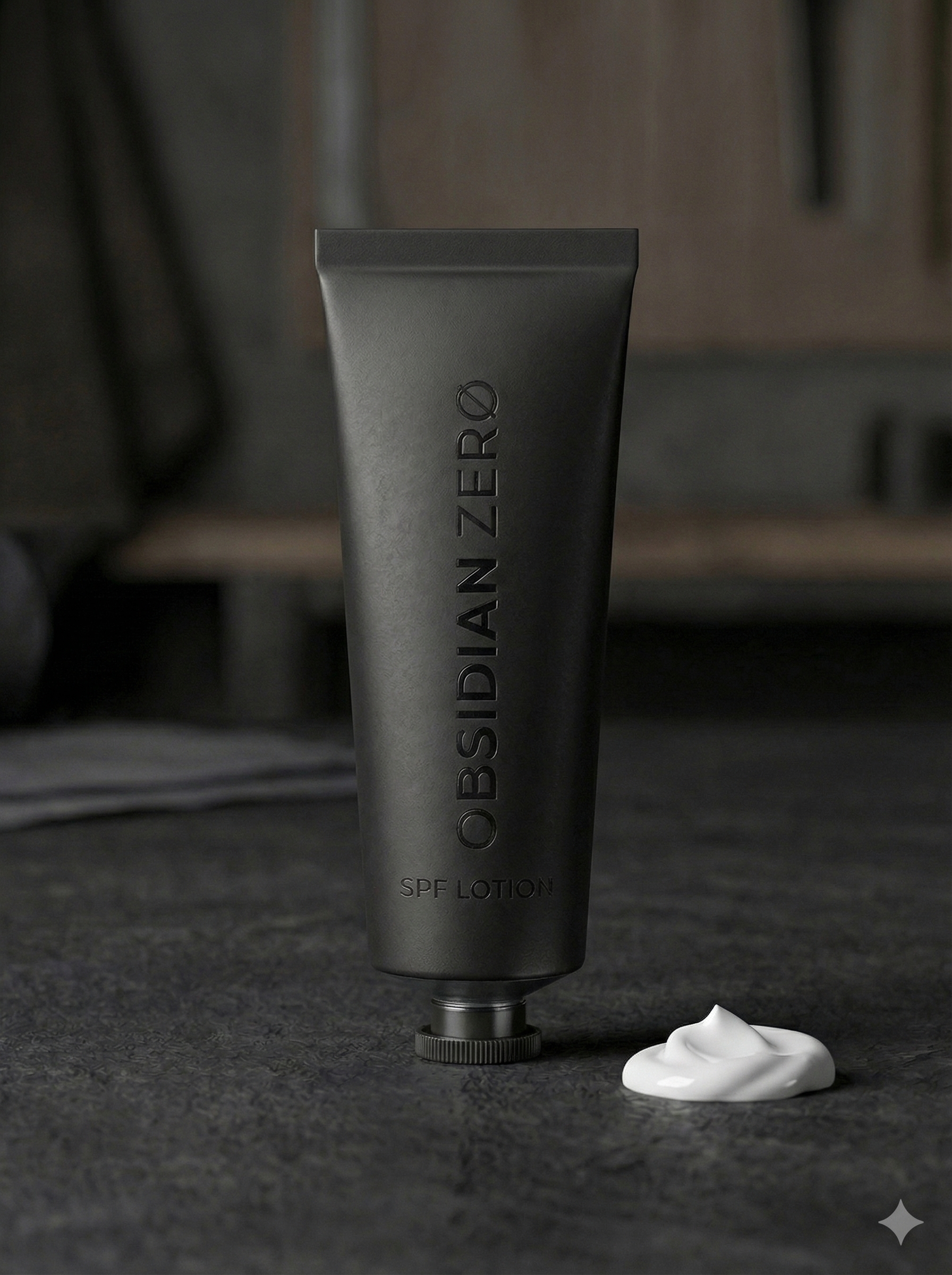
100% mineral. PA++++. No excuses left.
Zinc Oxide 15% + Titanium Dioxide 6%. Zero white cast. Absorbs in seconds.
Shop Obsidian ZeroFrequently Asked Questions
Do I need to wear sunscreen indoors?
If you sit near a window or work under fluorescent lights, yes. UVA penetrates standard glass. Significant indoor UV exposure can occur within 1–2 meters of a window. If your workspace has no natural light, the risk is minimal — but applying SPF in the morning takes 30 seconds and removes the question entirely.
Can I use body sunscreen on my face?
Technically yes, but body sunscreens are formulated for thicker, less sensitive skin. They're often greasier, heavier, and not designed to be non-comedogenic. Using a facial-specific formula is preferable for daily use, especially if you're oily or acne-prone.
Does SPF in foundation count?
The same under-application problem applies. Foundation with SPF 30 applied lightly delivers a fraction of SPF 30 protection. Use a dedicated SPF underneath foundation if you wear it, and treat any SPF in cosmetics as a supplement, not a substitute.
How often do I need to reapply?
For typical indoor-outdoor daily use, one morning application is sufficient. If you spend 2+ hours in direct sun, reapply every 90 minutes. Mineral SPF is more photostable than chemical alternatives, meaning it degrades more slowly under UV exposure.
Sources
- 1. U.S. Sunscreen Use When Outside Among Men 2023 — Statista, 2023
- 2. Patterns of Sunscreen Use on the Face and Other Exposed Skin Among US Adults — PMC, 2015
- 3. A Comprehensive Review of the Role of UV Radiation in Photoaging Processes — PMC, 2024
- 4. Photoaging: What You Need to Know About the Other Kind of Aging — Skin Cancer Foundation, 2021
- 5. Application Habits and Practices of Regular Sunscreen Users — Food and Chemical Toxicology, 2023