SPF 50 vs SPF 30: What Men Actually Need for Daily Use
The numbers are close on paper. In practice — where most people apply 20–60% less sunscreen than tested — the gap between SPF 30 and SPF 50 is significant. Here's the data on what you actually need.
What SPF Actually Measures
SPF — Sun Protection Factor — measures how much longer it takes for UVB radiation to cause a burn compared to unprotected skin. An SPF 30 product means it would take 30 times longer to burn with it applied versus without. In percentage terms: SPF 30 filters 96.7% of UVB rays, SPF 50 filters 98%, and SPF 100 filters 99%.
That 1.3% difference — from 96.7% to 98% — appears marginal. In practice, the relevant number isn't the percentage blocked but the percentage that gets through: SPF 30 allows 3.3% of UVB through, while SPF 50 allows 2%. SPF 50 transmits 40% less UVB than SPF 30. That's the actual comparison.
Critically: SPF only measures UVB — the burning rays. It says nothing about UVA, which penetrate deeper into the dermis and are responsible for the majority of photoaging effects: wrinkles, collagen breakdown, and hyperpigmentation. A 2024 comprehensive PMC review confirmed UV exposure is responsible for up to 90% of visible skin changes. This is why broad-spectrum labeling and UVA rating systems matter separately from the SPF number.
The Real-World Application Problem
SPF ratings are tested in labs at a standardized dose of 2mg per square centimeter of skin. In practice, a 2023 study published in Food and Chemical Toxicology found that 20–60% of regular sunscreen users don't apply the amount required to achieve the labeled protection. A separate 2025 CivicScience survey found more than 1 in 3 US adults don't reapply throughout the day.
Under-application dramatically reduces effective SPF. The math is not linear: applying half the required amount doesn't give you half the protection — it gives you approximately the square root of the labeled protection. Applying 50% of the required SPF 30 amount gives you roughly SPF 8, not SPF 15.
Application amount
SPF 30 → effective
SPF 50 → effective
Full (2mg/cm²)
SPF 30
SPF 50
75% applied
~SPF 17
~SPF 27
50% applied
~SPF 8
~SPF 12
25% applied
~SPF 3
~SPF 5
At real-world application rates, SPF 50 consistently outperforms SPF 30. The higher SPF acts as a buffer for the under-application that happens in practice — giving you meaningful protection even when technique isn't perfect.
Daily Use vs. Extended Outdoor Exposure
The recommendation differs by context. For extended outdoor time — beaches, hiking, water sports, manual outdoor work — SPF 50 plus reapplication every 90 minutes is the dermatologist standard. The reapplication schedule matters as much as the SPF number here: photodegradation of sunscreen filters reduces protection over time, particularly with chemical filters.
For daily urban use — commuting, working indoors, walking to lunch, driving — SPF 50 applied once in the morning is sufficient for most men who aren't spending prolonged periods in direct midday sun. Windows block UVB but not UVA, which means men who spend significant time driving or near windows are accumulating UVA exposure without the burning signal that prompts reapplication.
The argument that 'SPF 30 is enough for everyday' assumes perfect application technique — a 2023 study shows the majority of users don't apply enough. SPF 50 is the more practical choice for daily wear precisely because it accounts for real-world margin of error. It's not about being cautious; it's about being realistic about how people actually apply sunscreen.
UVA Protection: What SPF Doesn't Tell You
The SPF number on a sunscreen tells you about UVB protection only. UVA — which constitutes approximately 95% of UV radiation that reaches the earth's surface — is responsible for the majority of photoaging: collagen breakdown, wrinkles, hyperpigmentation, and deeper DNA damage. The Skin Cancer Foundation confirms UVA penetrates clouds and glass and is present at consistent levels year-round, not just in summer.
US Broad Spectrum labeling indicates some UVA protection but doesn't mandate a specific measurement standard. The PA+++ / PA++++ rating system — used widely in Asian sunscreens — provides a tiered UVA measurement: PA++++ is the highest available UVA protection standard. For men focused on preventing photoaging (not just sunburn), PA++++ is the specification to look for alongside SPF 50.
Zinc oxide (one of the two mineral UV filters) provides broad-spectrum coverage that includes UVA1 and UVA2 — the full UVA spectrum. It's one of the reasons mineral SPF is recommended over chemical SPF for daily facial use: the protection profile is broader, not just the UVB number.
Mineral vs. Chemical for Daily Facial Use
For daily facial use, mineral filters (Zinc Oxide, Titanium Dioxide) have clear practical advantages over chemical filters. Mineral filters work immediately upon application — no 20-minute activation window. They're photostable, meaning they don't degrade under UV exposure throughout the day. They're less likely to cause irritation or clog pores, which matters for a product applied to the face daily.
Chemical filters like avobenzone are inherently photounstable — they absorb UV and convert it to heat through a chemical reaction, degrading in the process. Avobenzone requires photostabilizers (like Helioplex or tinosorb) to maintain efficacy through the day. For a product you're wearing 8–12 hours daily, the photostability of mineral filters is a meaningful practical advantage.
The historical objection to mineral SPF — the white cast from zinc oxide — has been largely addressed by modern formulations using micronized zinc particles. Formulations designed for facial use, particularly those combined with matte base ingredients, apply clearly and leave no visible residue on most skin tones. For very deep skin tones, testing a specific formula is recommended, as residual tint varies by formulation.
For a deeper look at why men skip SPF altogether, see our guide on why men skip sunscreen and what it's doing to their skin.
How to Apply Sunscreen Correctly
Application quantity is where most people fail. The standard recommendation for the face alone is approximately 1/4 teaspoon (about 1.25ml). Most men apply significantly less than this — enough to feel like they've covered their face, but not enough to achieve the labeled protection.
Apply to dry skin
Sunscreen should go on clean, dry skin — after your cleanser has fully dried. Applying to damp skin dilutes the formula and creates uneven coverage. If you use other skincare products, sunscreen goes last (or second-to-last before moisturizer if you use both, though a good SPF eliminates the need for a separate morning moisturizer).
Cover the full face including ears and neck
Most men apply sunscreen to the center of the face and stop. The temples, ears, neck, and lower jaw receive significant UV exposure — particularly while driving — and are frequently missed. Photoaging on the left side of the face is consistently more pronounced in drivers in left-hand-drive countries, from window UV exposure.
Give it 30 seconds to set
Mineral SPF works immediately, but it benefits from a brief set time before touching your face, shaking hands, or pulling on clothing. 30–60 seconds is sufficient for the formula to adhere properly.
Reapply for extended outdoor exposure
For indoor daily use, one morning application is sufficient. For extended outdoor exposure (90+ minutes in direct sun), reapplication at 90-minute intervals is the evidence-based recommendation. SPF sprays are useful for reapplication over existing skin without disturbing any other products.
Why Men Skip SPF (And What It's Costing)
Statista data from 2023 shows that a significant portion of US men don't use sunscreen when outside. The reasons are consistent across surveys: it feels greasy, takes too long to apply, doesn't seem necessary, or is associated with beach use rather than daily routine.
The cost of consistent non-use is significant. A 2024 PMC review confirmed that UV exposure drives up to 90% of visible skin changes including wrinkles, loss of elasticity, uneven pigmentation, and enlarged pores. The Skin Cancer Foundation calls this photoaging — and it's cumulative, irreversible, and preventable. The dark spots that appear in your 30s and 40s were largely set in motion by UV exposure in your 20s.
The greasy texture objection is solved by choosing the right product — specifically a matte-finish mineral SPF designed for daily facial use, not a body sunscreen applied to the face. Applied correctly, these formulas feel like nothing and leave no residue. There is no significant time barrier to SPF application when it's integrated into the existing morning routine as the final step.
Related Reading
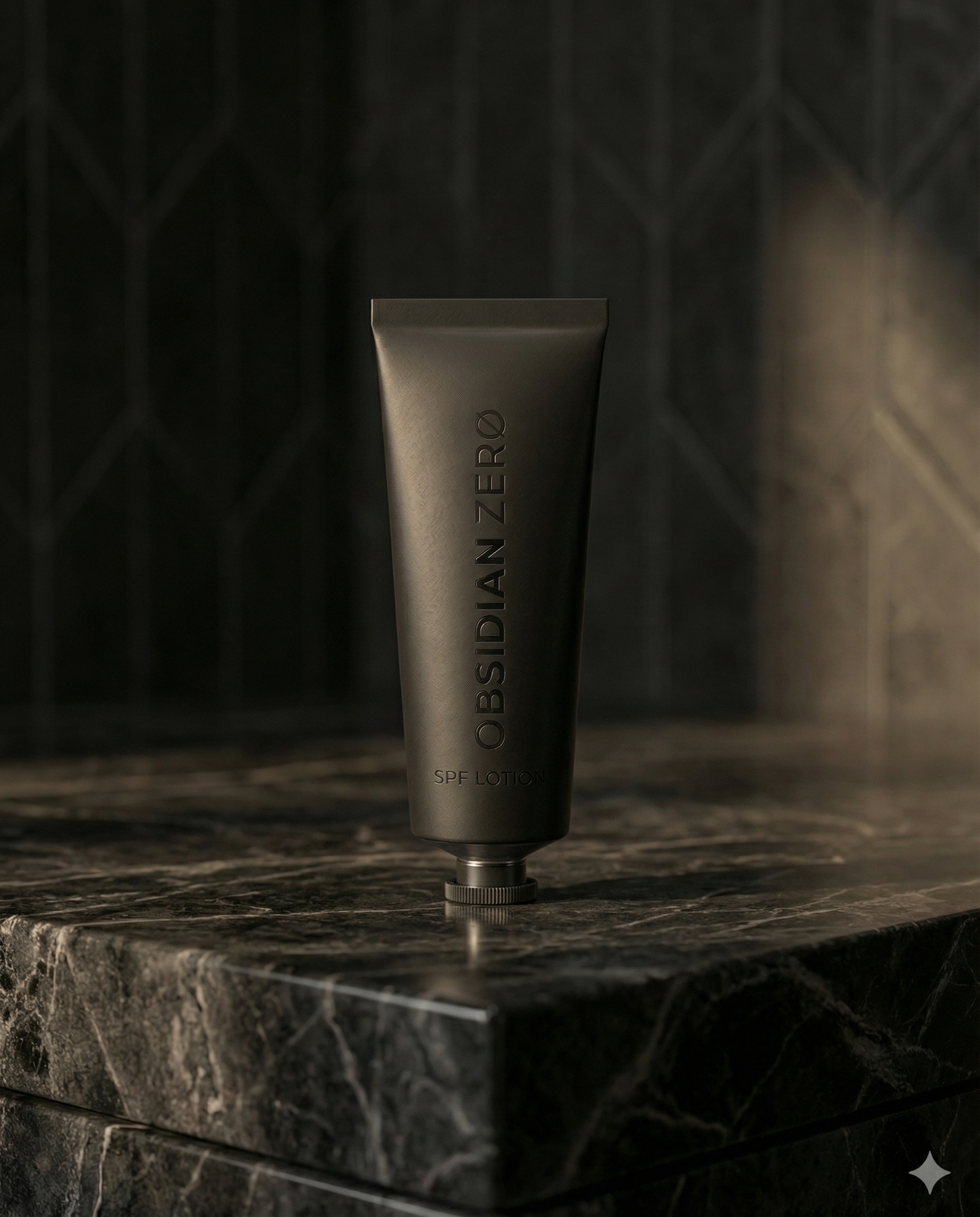
SPF 50. Mineral. PA++++.
Zinc Oxide 15% + Titanium Dioxide 6%. Photostable. Applies in seconds with no white cast. Built for daily use.
Shop Obsidian ZeroFrequently Asked Questions
Is the difference between SPF 30 and SPF 50 actually meaningful?
In lab conditions with perfect application technique, the difference is 1.3% more UVB blocked. In practice, it's more significant: SPF 50 transmits 40% less UVB than SPF 30 (2% vs 3.3% transmission), and the buffer it provides for real-world under-application is substantial. When most users apply 50–75% of the required amount, SPF 50 at 75% application still outperforms SPF 30 at full application. The gap matters when application is imperfect — which is most of the time.
What does PA++++ mean and why does it matter?
The PA rating system (Protection Grade of UVA) is the UVA equivalent of SPF. PA++++ is the highest available UVA protection grade. The SPF number tells you about UVB protection only; PA++++ tells you about UVA protection. Since UVA is responsible for the majority of photoaging — wrinkles, collagen loss, hyperpigmentation — PA++++ is arguably more important for anti-aging purposes than the SPF number. US Broad Spectrum labels don't use this system and have no standardized UVA measurement requirement.
Do I need to reapply sunscreen if I'm working indoors?
For primarily indoor days — offices, homes — one morning application of SPF 50 is sufficient. UVB doesn't penetrate standard glass; UVA does, but at reduced intensity through standard windows. If your desk is directly next to a window with prolonged direct sun exposure, or if you're driving for extended periods, reapplication at midday is worthwhile. For outdoor exposure exceeding 90 minutes, reapplication is necessary regardless of SPF level.
What's the best SPF for men with oily skin?
A matte-finish mineral SPF 50 (zinc oxide or titanium dioxide) designed specifically for facial use. These formulas are engineered to be non-comedogenic and matte, and many actually reduce the appearance of shine versus wearing nothing because the mineral particles absorb surface oil. The key is choosing a formula made for facial use — body sunscreens tend to be heavier and more occlusive. Avoid SPF products with silicones if they tend to pill under your environment. For oily skin, the SPF also functions as your morning moisturizer, eliminating one step from the routine.
Sources
- 1. Application Habits and Practices of Regular Sunscreen Users — Food and Chemical Toxicology / ScienceDirect, 2023
- 2. Sunscreen Usage in 2025: Skepticism and Skincare Interest Shift Usage and Growth — CivicScience, 2025
- 3. A Comprehensive Review of the Role of UV Radiation in Photoaging Processes — PMC / PubMed, 2024
- 4. Photoaging: What You Need to Know About the Other Kind of Aging — Skin Cancer Foundation, 2021
- 5. U.S. Sunscreen Use When Outside Among Men 2023 — Statista, 2023